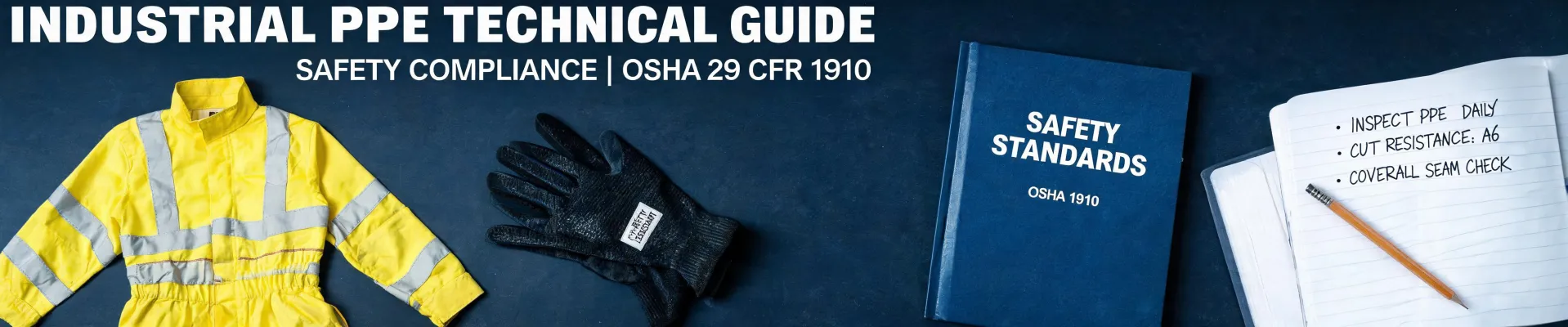
In January 2021, I accepted a promotion I probably wasn't ready for. Safety coordinator at a 140-person food packaging plant. My boss, with the best intentions, said: "We need a Dupont-level safety program. Make it happen."
I nodded. Then I googled "Dupont safety program" and realized I was in way over my head.
I'm not sharing this to discourage anyone. I've spent three and a half years in the role now. I've personally made (and documented) seven significant mistakes, totaling roughly $16,000 in wasted budget. But here's the thing: that first year of failures taught me more than any training course ever did.
This is the story of those failures. And the checklist that came out of them.
The Glove Disaster That Should Have Been Obvious
My first big assignment: stock the floor with new PPE. Gloves, safety glasses, hearing protection. Easy, right?
I ordered from a generic industrial supplier without digging into specs. Cut-resistant gloves—the cheapest ones. Safety glasses in bulk. I checked it myself. I approved it. Three weeks later, 700 pairs of gloves showed up.
The floor team hated them. "These are for light assembly," one line lead told me, holding up a pair. "We're handling steel containers with crimped edges. These'll last a day."
He was right. They lasted three shifts.
That's when I learned lesson one: PPE selection starts with a hazard assessment, not a product catalog. I had it completely backwards.
People think buying expensive safety equipment creates a safe program. Actually, it's the other way around. A safe program starts by identifying specific hazards, and then the right equipment is chosen to close those specific gaps. Equipment purchased without a hazard assessment is just expensive inventory.
The mistake cost us about $2,300 plus a week of grumbling from the floor. It also taught me why OSHA's PPE standard (29 CFR 1910.132) requires documented hazard assessments. It's not bureaucratic paperwork. It's the foundation.
We redid the process properly. ANSI/ISEA 105 levels. Cut resistance. Grip. And we asked the people who actually wore the gloves—a step that seems obvious now but wasn't obvious to me then.
The Fall Protection Temptation
In September 2022, we installed a new mezzanine system. That meant fall protection for maintenance workers at height.
I requested quotes from three suppliers. One was Guardian Fall Protection—this was my first real introduction to the Dupont safety portfolio. The other two were generic equipment brands I won't name. Their prices came in 30-40% lower.
The numbers said go with the budget option. Similar load ratings on paper. Similar harness specs. My gut said something was off.
I asked both budget suppliers for third-party test data. Specifically, I wanted drop-test reports and harness buckle-cycle test results. One said—I quote—"we'll get back to you." The other sent a single-page spec sheet with no test reference at all.
The Guardian rep sent a binder. Certifications. Test methods. The name of the engineer who signed off on the harness line.
The upside was $3,200 in savings. The risk was a broken body. I kept asking myself: is $3,200 worth the phone call I'd have to make to someone's family?
I went with Guardian. Cost more. Worth every dollar.
Here's what convinced me, looking back: the budget vendors didn't understand their own equipment's limits. When I asked "what's this harness rated for in a 6-foot free fall with a 220-pound worker?" the answers were vague. The specialist answered without hesitation.
I began to understand something important. The vendors who claim to do everything end up being mediocre at most of it. The ones who can tell you exactly what they're good at—and what they're not—are the ones you can trust.
The Water Fire Extinguisher Question
This one still embarrasses me.
We needed to replace fire extinguishers in the packaging hall. A colleague, repeating something they'd heard somewhere, said: "Just get water fire extinguishers. They're the safest, most universal option."
I almost ordered them based on that advice. Fortunately, I called our safety supply vendor first.
The response was a single word: "Don't."
Water extinguishers are Class A only. Our packaging hall has electrical equipment (Class C) and hydraulic fluid lines (Class B). A water extinguisher on an electrical fire causes more problems than it solves—electrocution risk, equipment damage, and a fire that's still burning. (Which is the short version of why NFPA 10 exists.)
The vendor sold both types. They didn't make extra money steering me toward ABC dry-chemical extinguishers. They just didn't want to see a preventable catastrophe. That conversation earned them our business for as long as I'm in this role.
People think a good supplier sells you whatever you ask for. Actually, a good supplier tells you when you're wrong. That's not common, and when you find it, you hold onto it.
The Healthcare PPE Confusion
During the COVID years, a relative who worked in hospital administration asked me, "What is PPE in healthcare, anyway? Is it the same as what you do?"
Mostly, I had to admit I wasn't the right person to answer. Industrial PPE and healthcare PPE share some items—gloves, eye protection, respirators—but the priorities are different. Different regulatory frameworks (OSHA vs. CDC guidelines), different usage patterns, different contamination risks. A disposable isolation gown and a Kevlar glove are both PPE, but they're solving completely different problems.
People think "PPE" is one category. It's not. It's a sprawling collection of context-specific tools. (That's what I say when people ask now.)
I told my relative the honest version: "I do industrial safety. Healthcare has its own specialists. I know people who do that."
It was a small moment, but it reinforced the lesson. Knowing what you don't know is a feature, not a bug.
What I Should Have Done From Day One
Looking back, the pattern is clear. I started with products. I should have started with the program.
A real safety program—the Dupont safety program model I was instructed to follow—isn't a stack of branded equipment. It's a system:
- Hazard identification before equipment selection (the step I skipped)
- Worker involvement so the gear actually gets worn (the step I skipped)
- Documented standards and workflows (the step I didn't know existed)
- Culture measurement, not just compliance tracking (Dupont's Bradley Curve approach)
Eventually, I attended a safety leadership workshop at Dupont's headquarters—3500 South Dupont Highway in Dover, DE 19901. Walking through their safety center was humbling. But the most valuable part was their emphasis on knowing the boundaries of your expertise. That's rare in any industry.
Rare enough that it changed how I run our program.
The Checklist That Saved My Reputation
In Q1 2024, after a near-miss involving an expired-lot respirator shipment that would have failed an audit, I created a pre-order safety checklist. Before we buy any PPE now, we answer five questions:
- What specific hazard are we addressing? (Reference: OSHA 29 CFR 1910.132)
- Have we talked to the workers who'll use it every day?
- What standard applies, and can we cite it? (ANSI, NFPA, CDC—all are fair game)
- Does the vendor have verifiable third-party test data?
- Who's the independent reviewer who can say "this is wrong"?
In the past 18 months, that checklist has caught 31 potential errors. Thirty-one. Including a fall protection order that would have been grossly undersized for our beam configuration. That was a gut-vs-data moment, permanently resolved by asking better questions.
Worse than expected? No—better. Not perfect, but workable.
The Honest Summary
I failed a lot in the beginning. The mistakes cost about $16,000. I lost credibility with our floor staff at least once, maybe twice. But we ended up with a program that's measurably safer.
Know what you don't know. The specialist who says "this isn't our strength—here's who does it better" will earn your trust forever. The generalist who overpromises will cost you. Literally. I have the invoices.
PPE is not the safety program. It's the last line of defense after you've identified hazards, listened to workers, and verified the equipment does what the manufacturer claims.
If you're about to buy safety equipment, ask yourself: did I start with the hazard, or with the catalog? Does the vendor have test data? And does anyone on my team have the confidence to say "I don't know—let's find out"?
Simple as that. But I learned it the expensive way.

Discuss this specification topic
Use the contact form if your team needs a standards crosswalk, datasheet request, or PPE program review related to this article.
Request Follow-Up