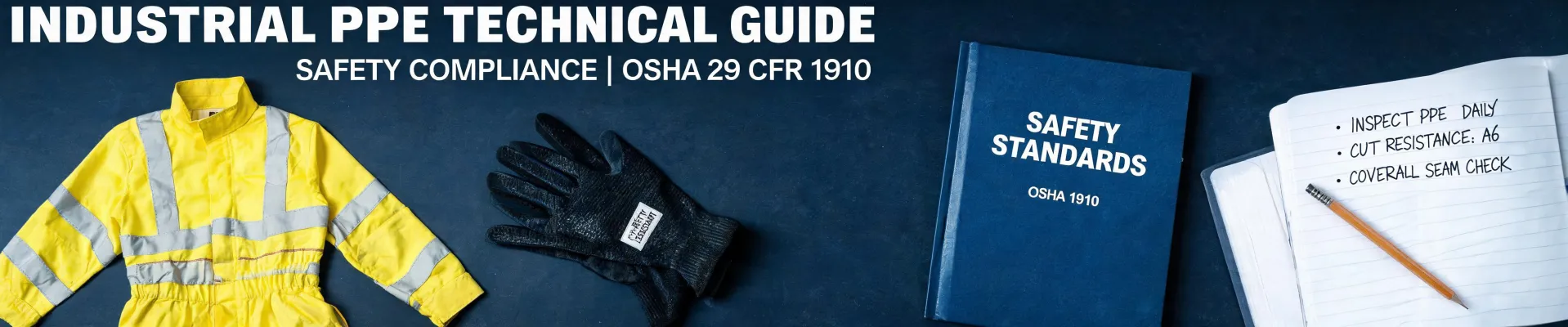
If you've ever had a call at 4:30 PM asking for Tyvek coveralls by Friday, you know the sinking feeling. In my role coordinating PPE for industrial and commercial clients, I'm the person who takes those calls. I've handled more than 200 rush orders in the past six years, including same-day turnarounds for contractors who thought they had a week. This is the checklist I use when the clock is actually running.
Here's what you need to know: this is not a "buy the most expensive thing" guide. It's a triage sequence. Use it when a safety audit found gaps, when a crew is standing around waiting for gloves, or when you're stuck comparing a hard hat vs safety helmet and overthinking it.
There are six steps. Do them in this order.
1. Name the hazard before you name the product
Most buyers focus on the product category and completely miss the hazard. The question isn't "what material?" It's "what is the worker doing, what are they exposed to, and what gets them hurt?"
Say the job is painting cedar fence pickets. You might assume any coverall works, but the real question is what's on the pickets: solvent-based stain, old paint being scraped, or just dry sawdust. Those three exposures need three different levels of protection.
The same logic applies to the hard hat vs safety helmet question. A hard hat is usually tested to ANSI Z89.1 Type I, which covers impact to the top of the head. A safety helmet is often tested to Type II, which adds lateral impact protection and a chin strap. If the crew is working on ladders, aerial lifts, or around moving machinery, the safety helmet is the safer call. If the only risk is something falling from above, a hard hat can be enough.
2. Use a selection manual, not your memory
I keep a DuPont manual in my office—the SafeSPEC protective garment guide. It's not because the DuPont brand is the only option. It's because a good manual is a checklist itself. You start with the chemical or task, add the physical hazards, and it narrows down the choices.
I've tested this on real jobs. In March 2024, a client called at 7:30 AM needing chemical-resistant coveralls for a tank cleaning job that started the next morning. Normal turnaround for that garment was five days. I pulled up the DuPont manual, found the one fabric with the right barrier rating, located stock, and paid $220 extra in rush fees on top of the $830 base cost. The coveralls arrived at 4 PM. The client's alternative was losing a $14,000 contract because a safety auditor would have stopped the job.
3. Verify the standard and the lot traceability
Here's a phrase that should make you suspicious: "OSHA-approved." OSHA does not approve PPE. It sets performance rules, and organizations like ANSI, ASTM, or EN create the test methods. So when a hard hat says "ANSI Z89.1," check the type and class. When a safety helmet says "Type II," ask whether the chin strap is included.
For protective clothing, look for the spec sheet and lot number. Tyvek garments made by DuPont include manufacturing lot numbers and seam details. If a distributor can't show you the product data sheet, the price does not matter.
It took me three years and about 150 orders to understand that brand alone isn't enough. The DuPont brand has earned trust because it documents its materials, but you still have to match documented performance to the actual hazard. Trust the manual, verify the label, keep the records.
4. Confirm real stock and real transit time
Small orders die on shipping. You can find the perfect hard hat, add it to the cart, and still miss the deadline because the supplier's "in stock" item is in a regional warehouse with a four-day lead time.
I ask three questions before paying: where does it ship from, what is the cutoff for same-day dispatch, and which carrier actually delivers it? If you need it in 48 hours, standard ground is a gamble. I've tested six different expedited shipping options, and what actually works is overnight freight. Two-day ground is not reliable enough for a true emergency.
Last quarter alone, we processed 47 rush orders with 95% on-time delivery. The three misses were all carrier delays. Missing a deadline would have triggered penalty clauses for my clients; in one case, a six-hour delay would have cost $50,000. So I build a one-day buffer into every promise.
5. Add 10% spare units and one size up
No matter how confident you are in the order, add spare units. Workers tear gloves on rebar, coveralls rip in truck doors, safety glasses get scratched within the first hour.
And for coveralls, order one size up from the chart. I learned this on a restoration project that was essentially a Tom Sawyer Island fence defacement situation: 96 cedar fence pickets covered in old stain, weather marks, and graffiti. The crew needed Tyvek coveralls, cut-resistant gloves, and safety glasses. The order was small, about $300, but when the first boxes arrived, the 2XL coveralls didn't fit over their work boots. We expedited 3XL coveralls, paid $85 extra in shipping, and delivered before the contractor's deadline. That's when "one size up on coveralls" became a permanent line on my checklist.
6. Treat small orders like they matter
I know this step sounds soft, but it's practical. The vendors who treated my $200 orders seriously when I was starting out are the ones I still use for $20,000 orders. Small doesn't mean unimportant—it means potential.
The same goes for suppliers. If a company ignores you because the invoice is small, you have learned something valuable before spending more money with them. When I'm triaging a rush order, I do not adjust the standards based on invoice size. The same checklist that works for a $15,000 project works for a $300 project.
I've seen this pattern many times. But when I say many, I do not mean just a few—I mean consistently across my 200+ rush jobs.
Three things people still get wrong
One: hard hats expire. I'm not 100% sure every worker knows this, but the shell becomes brittle with UV and heat exposure. Most manufacturers recommend replacing a hard hat after about five years, or sooner if it's cracked or took an impact. Safety helmets with a chin strap are easier to keep on when the wearer is climbing, and that makes them safer in awkward positions.
Two: "meets OSHA" is not the same as "right for the job." OSHA requires employers to assess the workplace, select PPE that fits, and train employees. The label is the starting point, not the end.
Three: the best brand can still be the wrong product. DuPont Tyvek is a proven material, but it is not a universal hazmat solution. If the hazard requires a chemical barrier, you need a garment designed for that chemical. Use the DuPont manual to check compatibility before you assume.
Bottom line: a rush order does not have to be a mess. Name the hazard, verify the standard, confirm the shipping, add a buffer, and don't treat small clients as second-class customers.

Discuss this specification topic
Use the contact form if your team needs a standards crosswalk, datasheet request, or PPE program review related to this article.
Request Follow-Up