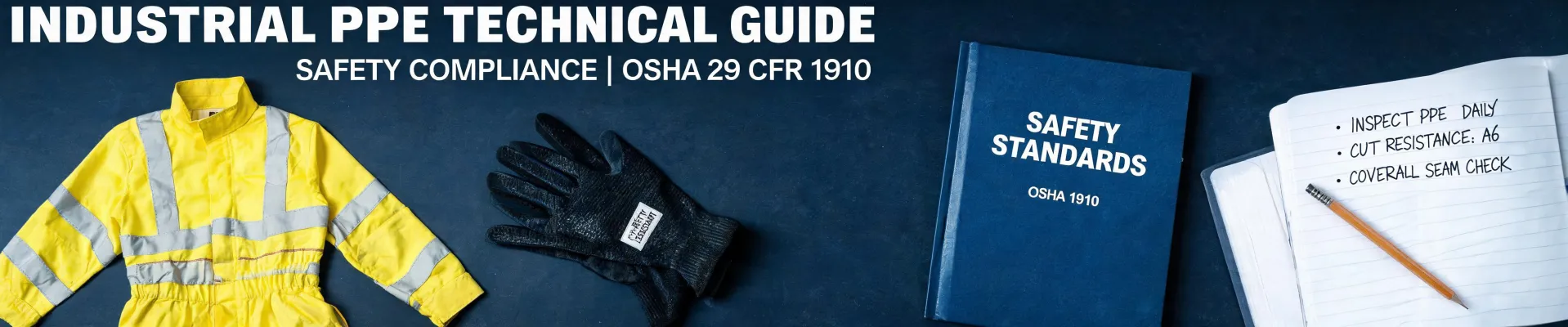
A white picket fence is a strange backdrop for a chemical exposure. But that's what it was — a row of neat, pointed palings framing someone's backyard in Saddle River, New Jersey, while one of our field technicians felt liquid splash hit the skin of his right forearm.
He was wearing a disposable coverall that I had approved. I'd chosen it because it cost $6.20 per unit — roughly half the price of the Dupont Tyvek suits we'd been buying. I'd run the numbers, presented the projected savings to the CFO, and felt pretty good about my negotiation. Five months and a second-degree chemical burn later, I can tell you exactly where my cost logic was wrong.
Why I Bought the Cheap Suits
Look, I'm a cost guy. I've been the procurement manager for a regional environmental remediation company for six years. We have 45 field technicians, and I manage an annual PPE budget of around $60,000. If an item gets ordered, it has a line item in my spreadsheet. That's the kind of person I am.
In late 2023, the company asked all departments to trim budgets. PPE was an obvious target — we were spending close to $14,000 a year on disposable coveralls alone. Around the same time, a supply house cold-emailed me a quote: 50-count cases of generic polypropylene coveralls, $6.20 each, delivered. The one-page spec sheet said 'liquid resistant,' 'breathable,' and 'CE Category III.' The product photos looked nearly identical to the Dupont Tyvek 400 disposable hazmat coverall suit we'd been using for splash-risk tasks.
I ran the comparison. Our standard suit cost $11.25 per piece in case quantities. The generic was $6.20. We ordered roughly 1,200 coveralls per year, so switching meant about $6,000 in savings — around 10% of my entire PPE budget from a single line item. I wrote a vendor-change note, got approval, and placed the first order in January 2024.
Here's the thing: I thought I was doing exactly what a cost controller should do. I'd compared quotes, evaluated the price, and calculated the savings. What I hadn't done was open the technical datasheet. What I hadn't done was ask what the CE Category III claim actually referenced. And I definitely hadn't asked the question that should drive every PPE purchase: which PPE can protect you from liquid chemicals — and under what conditions?
The Day by the Picket Fence
Fast-forward to June 2024. Our crew was at a residential heating oil tank removal in Saddle River, New Jersey. The client's backyard had one of those white picket fences — the classic suburban kind that feels permanent and safe. Our decon station was set up right beside it. The picture was absurd: a technician in a white coverall kneeling on a plastic pad, washing down a stained foundation wall, next to a storybook fence.
Marcus — a 23-year-old technician with about a year of field experience — was flushing that foundation wall with a diluted sodium hypochlorite solution. Roughly 10% bleach. Standard stuff for our line of work. The pressure washer kicked, the way they kick when the nozzle skips across a seam, and the spray caught his right forearm.
He felt it right away. That's the detail that still gets me. He felt the liquid hitting his skin through the suit. He stripped off the coverall in the decon zone, and within two minutes his forearm was red and starting to blister. The site supervisor drove him to the ER. The diagnosis: a second-degree chemical burn. He was out of work for six weeks.
The coverall he was wearing was one of the $6.20 units. The batch I approved.
What the Spec Sheet Didn't Say
We quarantined the remaining cases and pulled the technical documentation. That's when I learned how little the words 'liquid resistant' actually promise.
Our safety officer — a 30-year industry veteran — asked me a question I couldn't answer: 'What is the ASTM F1670 rating?'
ASTM F1670 is a standard test method for resistance to synthetic blood penetration. Along with ASTM F1671, which tests resistance to viral penetration, these are basic thresholds for a disposable coverall claiming splash protection. The Dupont Tyvek 400 suit had data for both. The generic suit I'd bought had no ASTM chemical test data at all.
Here's the communication failure in one sentence: the vendor said 'liquid resistant.' I heard 'chemical protective for our use cases.' They meant 'it will handle a light mist.' We were using the same words and picturing completely different realities.
That should've been a red flag. I didn't catch it because I didn't read past the first page.
Look, I realize now that 'CE Category III' and 'Type 5/6' sound reassuring. But Type 5 is about dry particles, and Type 6 is about a low-pressure light mist test — not a chemical barrier rating. A pressure washer throwing diluted bleach isn't a light mist. The spray forced liquid straight through that polypropylene nonwoven fabric.
The material difference is the core of it. Polypropylene is hydrophobic, but when the fibers are loosely packed, aqueous liquids wick through under pressure. Dupont Tyvek is made of flash-spun high-density polyethylene, which forms a much tighter nonwoven structure. That structure is why Tyvek has been the benchmark for disposable splash protection for decades.
The most frustrating part is that I had the datasheet. It was sitting in my inbox. I just never opened it.
During the same audit, we found a Class K fire extinguisher mounted near our chemical storage area. A Class K unit is designed for commercial kitchen grease fires — not flammable liquid or combustible metal fires. We don't fry food. A vendor had recommended a 'fire extinguisher package' the year before, and someone approved it on the rep's word. Same root cause: buying safety equipment based on a sales description instead of a hazard assessment.
Which PPE Can Protect You from Liquid Chemicals?
The honest answer: it depends on the chemical, the concentration, the pressure, and the duration of exposure. There's no single suit for every scenario. But I can tell you what we look for now.
For dilute aqueous chemicals — cleaning solutions, diluted bleaches, oil-stain removers — we standardize on the Dupont Tyvek 400. According to the Dupont product page (Dupont.com), the Tyvek 400 fabric passes ASTM F1670 and ASTM F1671, meets EN 1073-2 for radioactive particle contamination, and is certified CE Category III Type 5/6. That's documented splash resistance — not a marketing phrase.
Tyvek 400 is not a fully encapsulated Level A hazmat suit. It is not rated for concentrated solvents, gases, or immersion. For those hazards, we select a permeation-rated suit from the Dupont Tychem line, based on the specific chemical's breakthrough time. The lesson is to match the standard to the hazard, not the sticker price to the job title.
As of late 2024, the Tyvek 400 technical specifications are available on Dupont.com. Standards and product lines change, so verify current data before you make a procurement decision.
What the Cheap Suit Actually Cost
Let's do the math the way I should have done it in 2023.
The projected saving: about $6,000 per year.
The incident cost:
- Medical treatment and follow-up: roughly $9,000
- Six weeks of lost field time: about $8,400
- Overtime for replacement coverage: $4,200
- OSHA recordkeeping, investigation, and compliance hours: around $6,500
- Workers' comp claim administration and the resulting insurance scrutiny: still accruing
That's over $28,000 on the low end — before counting the human cost. A difference of $5 per suit between a certified product and a lookalike cost us over four times what we saved.
I still kick myself for not opening the datasheet. Twenty minutes of reading would have caught the gap before the first case ever went to the field.
Today we run a two-tier inventory. Dupont Tyvek 400 suits for tasks with liquid-splash or biological exposure risk. The generic polypropylene suits are used for strictly dry-particulate work, where they are safe and still economical. The net budget increase is around $4,000 a year. I approve that expense without hesitation.
When someone asks which PPE can protect you from liquid chemicals, the answer isn't a price point and it isn't a brand. It's the test data.
Find a suit with documented penetration resistance for the specific liquid you work with — and read the datasheet yourself. For our crews, the Dupont Tyvek 400 disposable hazmat coverall suit remains the standard because its performance on paper matches its performance in the field. That alignment is the real total cost win.

Discuss this specification topic
Use the contact form if your team needs a standards crosswalk, datasheet request, or PPE program review related to this article.
Request Follow-Up