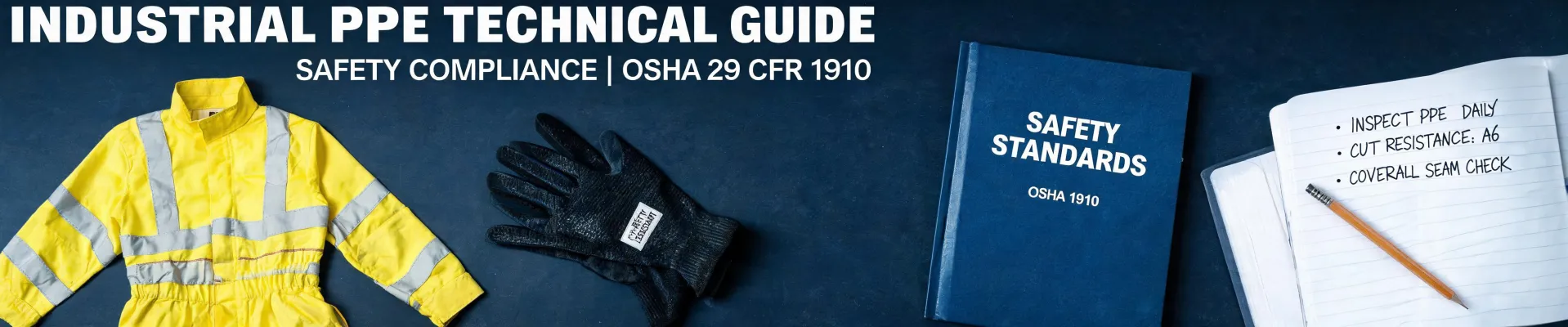
If you've ever driven South Dupont Highway past the Harrington Raceway & Casino in Harrington, DE, you know the stretch of industrial yards that follows. Ours is behind the black fence—the one with the faded sign and the parking lot that's still muddy in March. I've been the office administrator here for a little over five years, managing purchasing for a 150-person company. The question I get asked more than any other, by new hires and finance folks alike, is this: who is responsible for buying PPE?
The neat answer is "the employer." The real answer is more complicated. I ended up as the default PPE buyer without a title that said anything about safety. This is the story of how that happened, and how a pair of split-palm gloves taught me more about PPE performance and prevention than any training video ever did.
How the Responsibility Landed on My Desk
When I took over purchasing in 2020, we had no real system for safety equipment. If someone ran out of gloves, they yelled across the warehouse. Someone scribbled a list. The list eventually reached my desk, and I ordered whatever was cheap from whichever vendor answered the phone. It worked, sort of, the way a leaky faucet "works."
I didn't think much of it at first. PPE is PPE. Safety glasses are safety glasses. A glove is a glove—you buy them, you stock them, people wear them. That was my thinking, anyway.
The $1,800 Glove Mistake
In early 2023—February, I want to say, though I might be mixing it up with the March order—our regular glove supplier raised prices by about 12%. I was annoyed. Then a new vendor cold-called me. Their cut-resistant Kevlar gloves were $6 a pair cheaper than what we were paying. Maybe $5.50; I'd have to dig up the old quote. I did the rough math: we cycle through about 350 pairs a year in the warehouse alone. That's over $2,000 in projected savings.
I switched suppliers.
The first complaints arrived around April. "These don't breathe as well." "The cuff is kind of flimsy." Then a worker in the wash-down bay found a split palm after two days of use. A Kevlar glove marketed for cut resistance shouldn't fail at the seam after two shifts.
By the time we pulled the defective stock, we had maybe half the order left. We reissued backups from the emergency shelf, placed a rush order with our original supplier at a premium, paid expedited freight, and disposed of the junk gloves. Between the wasted stock and the reorder costs, the episode set us back about $4,800.
So: saved $2,000, spent $4,800. Net loss, roughly $2,800—give or take. I stopped calculating once the headache set in.
PPE Performance Is Not a Spec Sheet
I used to compare protective equipment the way you'd compare printer paper: same spec, lower price, done. But "same spec" is often an illusion. The cheap glove had a similar cut-resistance rating on paper. It just didn't survive real work, because the cuff stitching was sloppy and the liner shifted. Ratings mean what the manufacturer's representative tested, not what your workers will experience Tuesday morning.
The same lesson repeated with coveralls. We use Tyvek suits for dry particulate and light splash. On paper, a generic spun-bonded polypropylene suit looks nearly identical to Dupont Tyvek 400 at a lower price point. Our crew found the generic suits tear at the crotch seam when you bend—which is exactly the moment you need protection most. We standardized back on Dupont for hazardous tasks. The price difference runs about $4-6 per suit.
A Note on 2025 Pricing
For context, here's ballpark industrial pricing we're seeing in early 2025 quotes: Tyvek 400 coveralls run roughly $8-14 per unit in bulk; Kevlar cut-resistant gloves run $10-25 per pair depending on liner weight and coating; basic safety glasses run $3-8 per pair. Your supplier pricing will vary—verify current quotes before you budget.
That's cheap insurance, if you ask me. But the real lesson was bigger than coveralls.
Who Is Responsible for Buying PPE?
The legal answer is straightforward. OSHA's 29 CFR 1910.132 requires employers to assess workplace hazards, select appropriate PPE, and provide it to employees at no cost, with a few exceptions for items like safety-toe boots in certain conditions. But "the employer" is an entity, not a person. Somebody has to decide what equipment to buy, from whom, and at what level of quality.
At our company, the honest answer for years was: nobody.
The safety coordinator assumed I had it because I signed the purchase orders. I assumed she had it because she ran the training. Operations assumed both of us had it, and they were glad not to think about it. That arrangement survived until a compliance audit in 2024, when the auditor asked to see our PPE hazard assessment. Each department pointed at everyone else.
That meeting is the reason I now keep a printed sign-off sheet in my binder. It's not glamorous, but it ended the blame game.
The fix was deliberately unexciting. We now follow the same protocol at our main yard near Harrington and at our distribution center at 3500 South Dupont Highway in Dover, DE 19901:
- The safety coordinator owns the hazard assessment. She reviews each role annually and after any process change. That document drives every purchase decision.
- Supervisors submit PPE requests through a short form. It takes 30 seconds and gives us a paper trail.
- I verify each order against the approved vendor list. If a product substitution comes into play, the safety coordinator signs off in writing first. That step alone would have prevented the glove disaster.
- Finance gets a monthly PPE spend report. Cost per employee, by category. Accounting stopped rejecting our invoices once they could see what each dollar was doing.
Is this system overkill for a 150-person company? Probably. But I'd rather be over-structured than face another auditor with no answer.
What I'd Tell Another Admin in the Same Position
If you're the person who inherited PPE buying without a title that says "Safety," here's what I wish someone had told me:
- Get the hazard assessment in writing before you buy anything. Even a one-page list beats a stack of assumptions. You need to know what the equipment is expected to do.
- Don't optimize unit price alone. Factor in failure rate, lead time, emergency reorder costs, and the labor required to replace failed gear. The cheapest quote is rarely the lowest total cost.
- Talk to the people who actually wear the equipment. The worker in the wash-down bay will teach you more about glove durability in one sentence than a datasheet will in five pages.
- Document who approved what and why. I keep one running email thread for all safety equipment substitutions. It's ugly, but it has saved us twice.
That said, I should note the limits of my experience. Our exposure profile is fairly standard for light manufacturing and warehousing. Chemical plants, welding shops, cleanrooms—those involve different risks, different standards, and different answers to the PPE performance question. At least, that's been my experience.
Prevention Is a Procurement Strategy
Looking back, the real shift wasn't about gloves or coveralls. It was about what prevention means in purchasing. We treat PPE as the last line of defense between a worker and a hazard. But the procurement decision is part of that defense. Five minutes of verification at the ordering stage beats five days of correction after a product fails.
So who is responsible for buying PPE? Legally, the employer. Operationally, the person who signs the P.O. But functionally, it's shared among whoever does the hazard assessment, whoever collects the requests, and whoever holds the vendor list. If that person is you, build the checklist now.
I still have a stack of those split-palm gloves in the storage shed. I keep them as a reminder. That $2,800 mistake was one of the best training investments this company never planned to make.

Discuss this specification topic
Use the contact form if your team needs a standards crosswalk, datasheet request, or PPE program review related to this article.
Request Follow-Up